
|
Getting your Trinity Audio player ready...
|
Eve has been evaluating the manufacturer’s electric pusher propellers for several months
Eve Air Mobility will power its eVTOL aircraft with an electric propulsion system developed by Beta Technologies. The company confirmed the selection of the electric pusher motors on December 2 after an evaluation process that started in the summer.
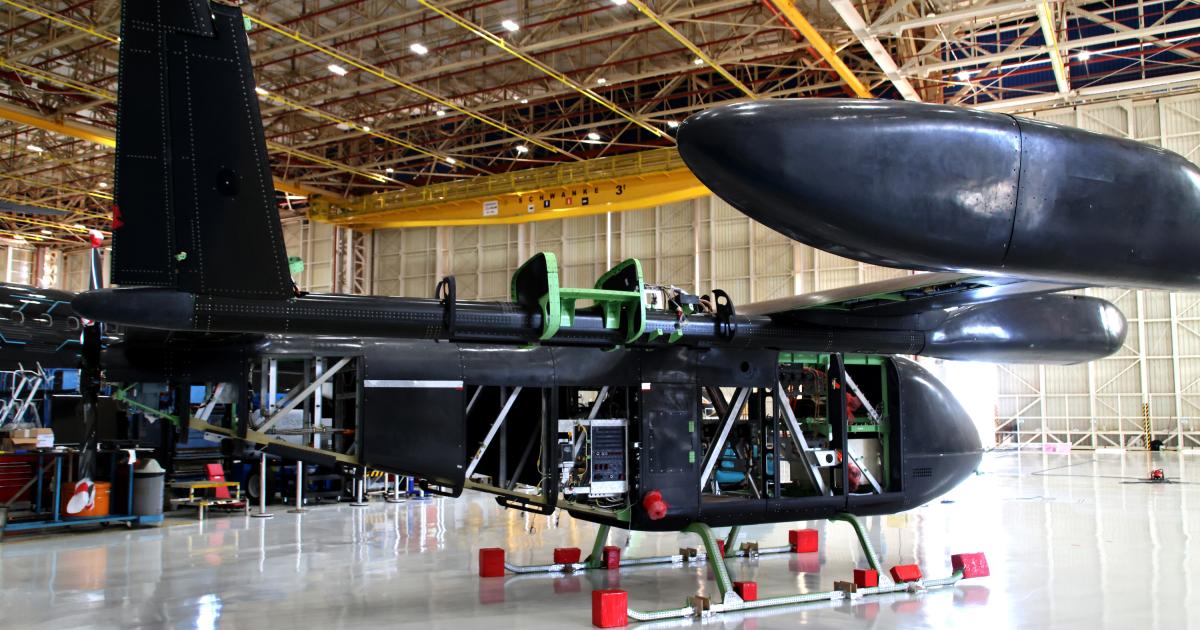
The powertrain has been tested on the ground with what Eve calls its “engineering prototype” for the four-passenger Eve-100 model, for which it is aiming to complete type certification in 2027. Eve said it is aiming to conduct a first flight with this aircraft in late December or early 2026, and then fly a conforming prototype by the end of next year.
The engineering prototype will start flight testing with a full set of 400-kilowatt Beta motors, powerint both the pusher and lifter functions. Eve said its contract with Beta for production conforming examples of the eVTOL aircraft cover just the pusher motors and these deliveries are due to start in 2026.
The engineering prototype does not incorporate design changes to the wing and new propellers. Eve unveiled these changes at the Paris Air Show in June and also announced Brazilian operator Revo as its latest customer for the air taxi.
Other key suppliers for the Eve-100 include battery supplier BAE Systems, Aciturri (wings), Liebherr (actuators), Intergalactic (thermal management) and Garmin (avionics), with sensors provided by Thales and Honeywell. The Embraer spin-off venture has shown a cabin interior that has been developed by Diehl Aviation and Recaro.
“Integrating Beta Technologies into our supply chain is a pivotal milestone in advancing our eVTOL program,” said Eve CEO Johann Bordais. “Their electric motor technology will play a critical role in powering our aircraft during cruise, supporting the maturity of our propulsion architecture as we progress toward entry into service.”
Vermont-based Beta is developing its own eVTOL aircraft, called the Alia 250, as well as a conventional takeoff and landing version called the CX300. The latter is expected to achieve FAA type certification by early 2027, with the VTOL model set to follow it to market around 12 months later. In early November, Beta raised around $1 billion through an initial public offering on the New York Stock Exchange.
“Our pusher motors have already proven high performance and reliability in thousands of demanding real-world operations across the globe, and our manufacturing capability will allow us to deliver these systems at scale to support Eve’s aircraft,” said Beta founder and CEO Kyle Clark. “This collaboration is another step in moving electric aviation toward commercialization and adoption.”
