
|
Getting your Trinity Audio player ready...
|
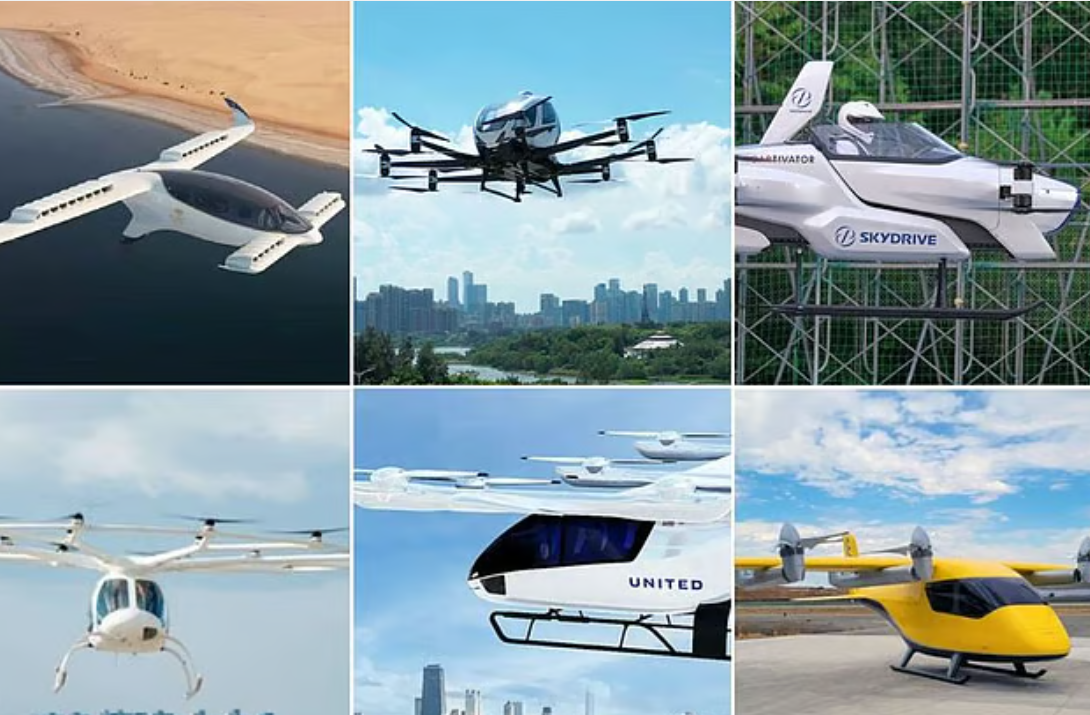
eVTOL: A number of passenger drone developers, backed by billions of dollars in investments, are making huge strides in rolling out next-generation electric vertical takeoff and landing (eVTOL) aircraft, aka air taxi. The current certification process, however, shows the big disconnect between eVTOL readiness and the systems required to deploy them.
Commercial “air taxi” service has been pushed back. Again.
Reason: It’s not because the technology doesn’t work or is unproven.
It’s because US certification timeline for the next-generation electric vertical-landing-and-takeoff (eVTOL) aircraft — a new mode for human flight — poses complex challenges, and keeps getting pushed back.
Currently, it’s stuck in regulatory snags, a hark back to the 1903 moment when the bicycle-maker Wright brothers successfully flew the first powered airplane at Kitty Hawk.
While their feat marked the beginning of modern aviation, there was no Federal Aviation Administration (FAA) to regulate it and ensure safety for everyone.
And there were no airports anywhere then.
For next-gen air taxis, safety rules are evolving, or non-existent, and “vertiports” are nowhere. Air taxis, though, can land/takeoff on existing helipads.
Why the delay?
Key challenge: Regulatory synchronisation
As it stands today, air taxi “operational infrastructure” is non-existent.
An industry report shows that the US certification timeline slip currently reveals: Joby won’t certify until mid-2027 at the earliest. Archer follows in 2028.
“The gap isn’t technical capability anymore. It’s regulatory synchronisation,” stated FAA’s Kalea Texeira in a LinkedIn post.
“The aircraft works. The business models hold. The capital’s top three players have runway through the end of the decade.”
“Vertiports. Energy supply chains. Part 135 integration. Pilot training frameworks that match the aircraft timeline,” explained Texeria, an FAA National Training Program Manager, Aviation Compliance & Data Analytics Expert.
She noted that while Dubai promised a commercial launch (in late 2025), “It didn’t happen. Not because the technology failed, but because regulatory approval cycles don’t compress on demand.”
FAA role
The FAA is tasked collaborate with federal partners per the Transportation Department’s AAM National Strategy, with the aim to accelerate market entry for US air taxi developers by streamlining regulations and infrastructure support.
But it’s not as simple as it seems: there’s a complex calculus and moving targets prior to full certification, alongside the development of pilot training, route planning and vertiport standards.
Result: None of the top eVTOL companies based in the US would see certification in 2026, according to an industry report.
Over in China, eVTOL developers and regulators are racing toward passenger certification in 2026, with EHang and AutoFlight.
New US bill: Could it speed up air taxi approval?
What the new bill is about:
A bipartisan bill introduced in the US Senate and House would require the Federal Aviation Administration (FAA) to streamline how it certifies electric vertical takeoff and landing (eVTOL) air taxis and other advanced air mobility (AAM) aircraft.
The goal: get US-built air taxis into service “faster” — but without lowering safety standards.
Backers of the legislation:
The bill — called the Aviation Innovation and Global Competitiveness Act — was introduced by a bipartisan group of lawmakers:
- Senate: Ted Budd, Peter Welch, Ben Ray Luján, and John Curtis
- House: Troy Nehls, Jimmy Panetta, and Jay Obernolte
Supporters say the measure is essential for keeping the US competitive as other countries race ahead on air taxi deployment.
