
|
Getting your Trinity Audio player ready...
|
At BonV Aero, our vision has always been simple yet audacious — to revolutionise aerial mobility, and eVTOLs are the cornerstone of that vision. Today, India’s urban centres are suffocating under gridlocked traffic, and traditional aviation serves only a privileged few. We are in constant pursuit of increasing our payload capacity, and we believe that fast, on-demand aerial commutes over congested cityscapes and complex mountainous terrain are no longer the realm of imagination; they are within reach.
From an environmental standpoint, eVTOLs represent a decisive departure from fossil-fuel-dependent rotorcraft and short-range aircraft. Our electric propulsion systems are optimised to deliver the desired torque and RPM with minimal energy consumption, making them inherently carbon-efficient. As India accelerates toward its net-zero commitments, eVTOL-powered urban air mobility will play a critical role in decarbonising the aviation sector from the ground up. At BonV, we are building the future of sustainable aerial transportation.
TimesTech: Your platforms are designed for complex terrains and critical missions. How is BonV Aero redefining logistics, especially for defence and disaster response scenarios?
Satyabrata: Our Air Orca heavy-lift UAV was built precisely for the environments where traditional logistics systems fail. India’s northern borders, Ladakh, Arunachal Pradesh, and Siachen, are extreme operating zones where roads vanish under snow and helicopters struggle to lift meaningful payloads. We solved that problem by setting a world record at Umling La Pass in Ladakh, lifting a 30 kg payload at 19,024 feet, surpassing even the Cheetah helicopter’s 20 kg limit at similar altitudes. The Air Orca has since been deployed with the Indian Armed Forces for high-altitude logistics, delivering rations, ammunition, and critical supplies with unmatched reliability.
For disaster response, this translates directly to life-saving speed. Whether floodwaters cut off Odisha’s coastal districts or landslides isolate Himalayan villages, our drones can drop medicines, food, and rescue equipment to inaccessible areas.
TimesTech: With increasing drone sightings in restricted areas, you’ve highlighted gaps in India’s counter-drone framework. Why do you believe signal jamming alone is no longer sufficient?
Satyabrata: Signal jamming was designed for a simpler threat environment, one in which rogue drones depended entirely on operator-controlled radio-frequency and GPS links. That world no longer exists. Today’s adversarial UAVs are increasingly equipped with onboard AI, pre-programmed flight paths, and inertial navigation systems that allow them to operate completely autonomously, even after communications are severed. Jamming the signal, therefore, does not neutralise the threat; it simply cuts the umbilical cord while the hostile drone continues flying toward its target.
The repeated drone sightings over sensitive installations are proof that our adversaries have already made this technological leap. A jammed drone carrying a payload does not fall safely, it may drift unpredictably or execute a pre-programmed mission without any operator involvement. Electronic countermeasures also create collateral risks in dense airspace, potentially disrupting legitimate aviation communications nearby. India’s counter-drone architecture must evolve urgently. We need layered responses: detection, electronic disruption, and physical neutralisation working in concert. Signal jamming is a tool, not a solution. Treating it as a complete defence is a vulnerability our adversaries are already exploiting.
TimesTech: BonV Aero is advocating for hard-kill counter-drone systems. Could you elaborate on how these systems work and their significance in strengthening India’s airspace security?
Satyabrata: No counter-drone measure is infallible. Despite the best signal jammers, there’s a possibility that some drones can sneak through. That is where hard-kill systems become very useful. Hard-kill counter-drone systems represent the final, definitive layer of airspace defence: the ability to physically remove a rogue UAV from the sky, not merely disrupt its signals. BonV Aero is actively advocating for the indigenisation of these systems under the Make-in-India framework, ensuring that this critical capability is produced and controlled domestically.
The most proven counter-drone approach we champion involves kinetic interceptors equipped with net-launcher technology. These interceptors detect, track, and physically ensnare hostile UAVs, capturing them intact and bringing them down safely in designated zones. Unlike missiles or directed energy weapons, net-based interceptors minimise collateral damage, making them ideal for use near populated areas, airports, and critical infrastructure. They are also highly effective against drone swarms; multiple interceptors can engage several simultaneous targets, defeating coordinated attack patterns that electronic countermeasures simply cannot handle.
For India, the strategic significance is enormous. Our borders, military bases, government complexes, and nuclear installations all require guaranteed physical protection against aerial intrusions. Hard-kill capability is a logical, operationally validated response to a rapidly escalating threat that India’s airspace security framework can no longer afford to ignore.
TimesTech: From defence to commercial logistics, your solutions have dual-use applications. How do you plan to scale this technology across industries while maintaining safety and compliance?
Satyabrata: Dual-use capability is a deliberate design philosophy at BonV Aero, not an afterthought. Our focus is on creating highly modular aerial platforms that can serve multiple use cases across defence, medical, law enforcement, and industry. This inherent versatility gives us a significant commercial advantage while amortising our defence-grade R&D investments across multiple verticals.
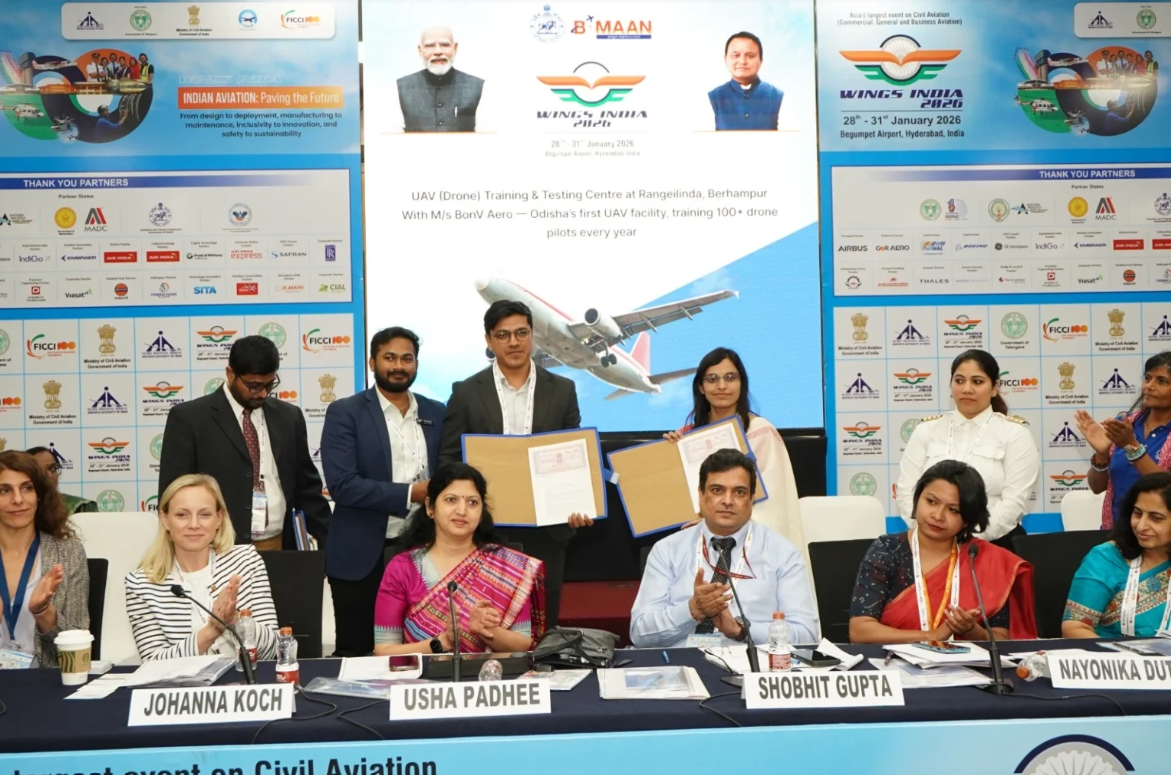
Our scaling strategy is anchored on creating compliant operational sandboxes first. We recently partnered with the Odisha government to revive the Rangeilunda airstrip under a DBOM model, transforming it into a national proving ground for high-density UAV operations. This model validates our technology in real-world regulatory and operational environments before wider deployment, giving both government and commercial clients the confidence to onboard our platforms.
Safety is non-negotiable at every scale. Our platforms are meticulously tested across all terrains, and our tech specs are validated through state-of-the-art field tests. This includes encrypted cybersecurity architectures that protect against signal interception and spoofing. We are simultaneously engaging with DGCA and MoCA to help shape BVLOS regulatory frameworks that are pragmatic, safety-first, and innovation-friendly, because scalable compliance is not a barrier to growth; it is the foundation for growth.
TimesTech: As a Make-in-India deep-tech startup with global ambitions, what challenges have you faced in terms of funding, regulation, and market adoption, and how have you overcome them?
Satyabrata: Building a deep-tech aerospace company in India from the ground up is an exciting opportunity. Yes, there are inherent challenges in scaling, but that is where our resolve as a company is tested.
In terms of funding, deep tech demands capital-intensive R&D cycles that far outpace conventional startup timelines. We secured early backing from IPV Ventures and subsequently won a grant from the legendary investor Tim Draper on “Meet the Drapers” — a global validation that completely changed our fundraising narrative.
In a nascent regulatory ecosystem, clarity can be a challenge. We tackled this through direct collaborations with the concerned stakeholders: by building directly with state governments, embedding ourselves in government innovation programs through STPI, and proactively demonstrating our platforms at Army trials and field exercises. Market adoption followed naturally from trust built through proven operational capability. Over time, thanks to the proven track records of our aerial platforms, we have generated significant interest in industrial partnerships and market expansion opportunities.
TimesTech: Looking ahead, what is your vision for India’s low-altitude economy, and how can collaboration between startups, government, and global partners accelerate its growth?
Satyabrata: India’s low-altitude economy (LAE) is arguably the most underutilised economic frontier we have today. The airspace below 1,000 feet is a vast, largely ungoverned resource that, if developed intelligently, could simultaneously transform logistics, defence, agriculture, disaster management, and urban mobility. At BonV Aero, our vision is for India to achieve total strategic and commercial sovereignty in this space.
The Rangeilunda initiative in Odisha is our proof of concept for how this can be done. By transforming a dormant public airstrip into a multi-stakeholder UAV hub, we aim to demonstrate how government assets, startup innovation, and academic research can converge to create replicable economic layers across the country. This is the model India needs: not isolated pilots, but interconnected ecosystems.
