
|
Getting your Trinity Audio player ready...
|
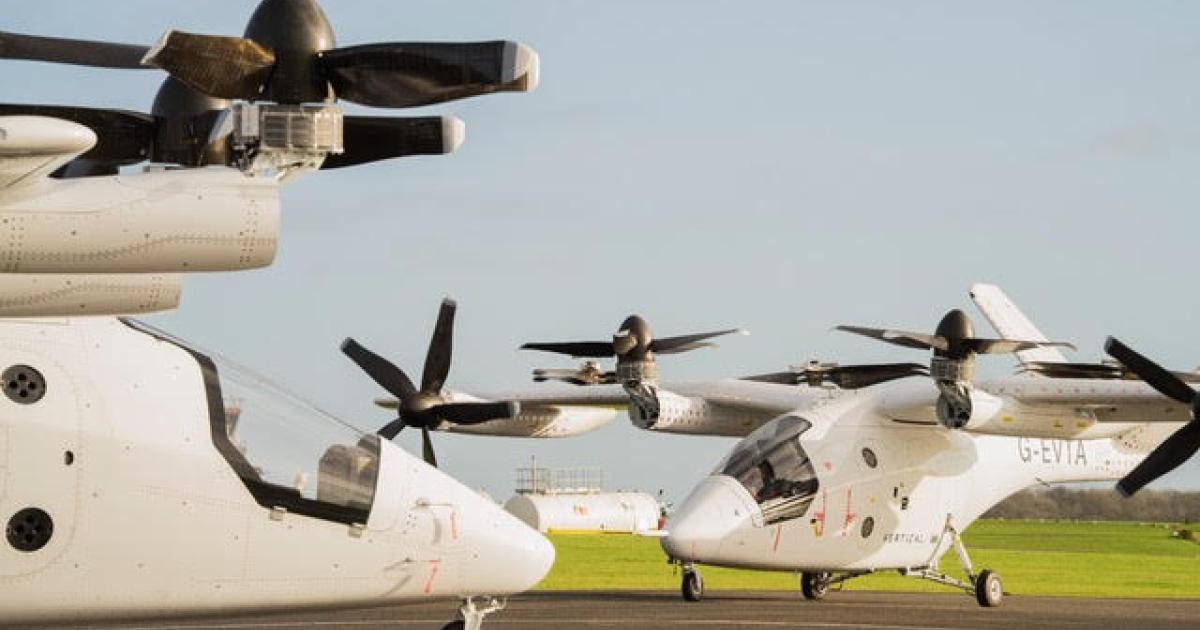
Vertical Aerospace has completed the construction of what it describes as its “third and final full-scale prototype aircraft,” which will double its current flight test capacity from early 2026. The readiness of the additional example of its VX4 eVTOL aircraft was announced on December 22, as the UK company seeks to maintain momentum as it targets a full piloted transition (moving from the hover to forward wingborne flight) early in the year.
Vertical’s second VX4 technology demonstrator has completed 10 flights since receiving its UK Civil Aviation Authority permit to fly last month. These have included several first-time achievements “including in-flight deployment and stow of the rear propellers, spin-up during wingborne flight, and prop-hold functionality,” explained Vertical. According to the UK-based company, around 10% of vertical lift propellor tilt transition work remains before a full transition flight can be made.
In May 2025, Vertical confirmed it had initiated the build of its third aircraft at partner GKN’s Global Technology Center to augment its existing piloted demonstrator. At the time, CEO Stuart Simpson explained the upcoming aircraft would help “accelerate flight test progress significantly over the coming year.” Vertical’s first full-scale VX4 aircraft was written off and subsequently scrapped following a propeller blade delamination in August 2023.
Once commissioned, the third aircraft will initially undergo testing in its all-electric configuration before being retrofitted to support hybrid-electric analysis. In May this year, Vertical revealed a hybrid propulsion system had been in development for 18 months, targeting a ten-fold increase in range to up to 1,000 miles (1,609 kilometres).
Flight testing of the VX4 will continue alongside development work for the recently-revealed upgrade to the VX4 design, named Valo. Vertical plans to build seven Valo units to be used for the upcoming type-conforming certification campaign, targeting regulatory approval for 2028, although it is unclear when the first flight of the Valo configuration is expected.
