
|
Getting your Trinity Audio player ready...
|
As much of Europe’s early air taxi hype cools, Munich-based ERC Systems is taking a different path. The company has begun flight testing its 2.7-tonne Romeo demonstrator, positioning a hybrid-electric successor for inter-hospital transfers and defence missions rather than urban passenger hops.
A new European eVTOL developer has stepped into the open with flight tests of a full-scale aircraft that is heavier and more mission-focused than most of its peers.
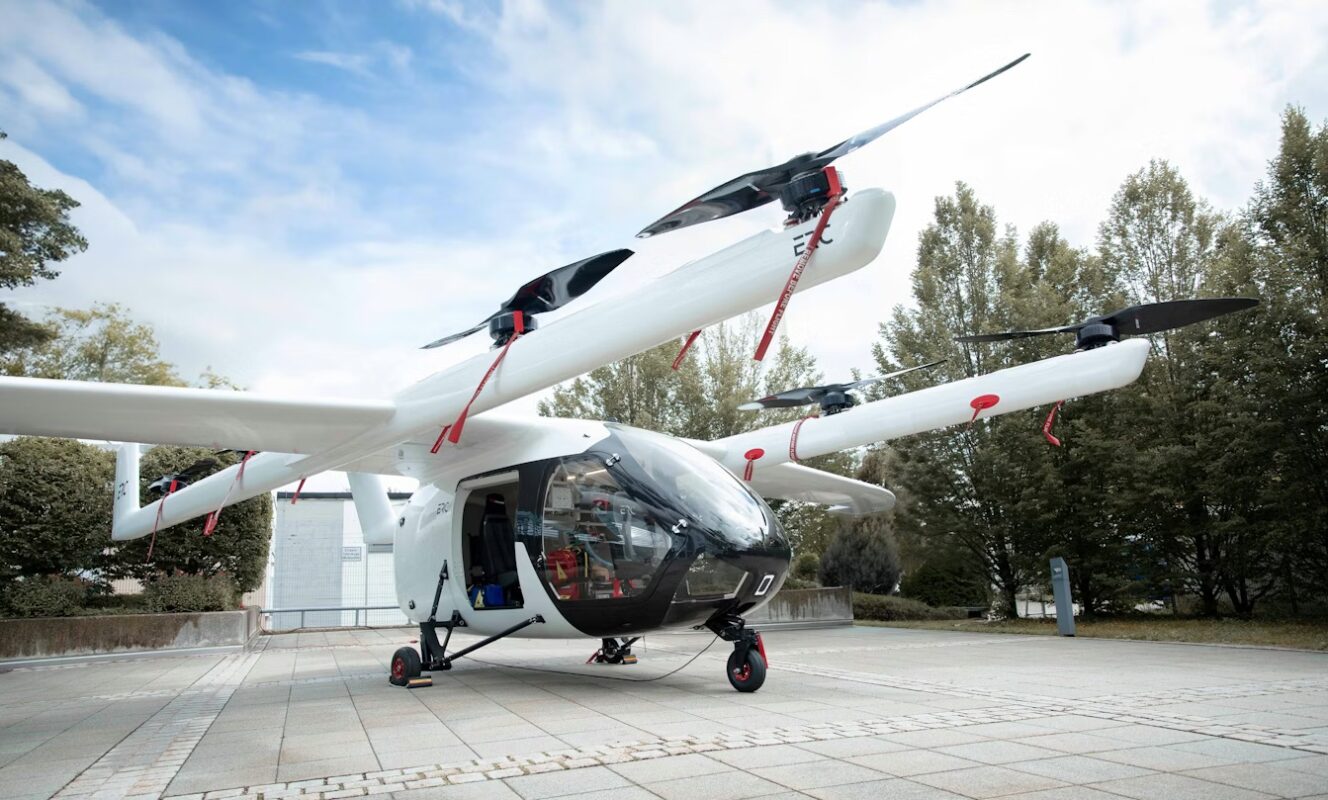
Munich-area startup ERC Systems has begun flying a 2.7-tonne demonstrator known as Romeo, marking the first public outing of a programme that had operated largely out of sight.
Rather than pitching urban air taxis, the company is targeting inter-hospital patient transfers, logistics and defence applications, arguing that these missions offer clearer operational demand and more predictable economics, reports Electrive.
The first public test flight took place at the former Erding airbase in Bavaria, now being developed as a Bundeswehr innovation centre. In front of invited media, the remotely piloted aircraft lifted to just under 10 metres and traced a brief figure-eight before landing after less than five minutes aloft. The sortie was modest, but symbolically important: it confirmed that Europe has another serious contender in the advanced air mobility field.
Europe’s heaviest eVTOL has flown
With a 16-metre wingspan and eight boom-mounted rotors arranged in a lift-plus configuration, Romeo is described by ERC as the heaviest eVTOL yet flown in the European Union, based on publicly available data.
The aircraft is currently limited to thrust-borne flight, hover and low-speed manoeuvres, with a second demonstrator due in the second quarter that will attempt full transition to wing-borne cruise.https://www.linkedin.com/embed/feed/update/urn:li:ugcPost:7426702084189802496?collapsed=1
Chief executive David Lobl has said mastering stable hover is the more complex challenge at this stage, with forward flight to follow once the propulsion and control architecture are validated.
Romeo builds on an earlier technology demonstrator, Echo, which first flew in 2023 and was used to explore distributed electric propulsion and battery redundancy concepts.
The new aircraft is closer to an industrial prototype, incorporating supplier hardware and production-style build practices to test not only flight performance but manufacturability.
Charlie hybrid-electric eVTOL targets 800km range and EASA certification by 2031
Data from Romeo will feed into ERC’s planned production aircraft, known as Charlie. Originally conceived as a fully electric platform, Charlie has since been redesigned around a hybrid-electric architecture. The shift reflects a pragmatic reassessment of battery progress and operational constraints.
Co-founder and chief commercial officer Maximilian Oligschlager has acknowledged that early industry expectations for battery energy density have not been realised at the pace anticipated. Purely battery-electric range proved insufficient for the inter-hospital mission profile, while charging infrastructure posed additional operational challenges.https://www.instagram.com/reel/DUkYn1yjOhb/embed/captioned/?cr=1&v=14&wp=810&rd=https%3A%2F%2Faerospaceglobalnews.com&rp=%2Fnews%2Fromeo-evtol-flight-germany%2F#%7B%22ci%22%3A0%2C%22os%22%3A1736.5999999046326%2C%22ls%22%3A982.0999999046326%2C%22le%22%3A1434.5999999046326%7D
The revised hybrid configuration will retain electric propulsion but add a fuel-powered generator acting as a range extender. ERC believes this will enable a maximum range of around 800 kilometres while preserving the lower maintenance profile associated with electric motors.
Charlie is planned to feature a 15-metre wingspan, a maximum take-off weight of 3,300 kg and a useful load of 500 kg. Certification is targeted for 2031 under EASA’s Special Condition VTOL framework, which applies a 10-9 safety objective equivalent to that required for commercial transport aircraft.
Why ERC Systems is focusing on medical transfers instead of urban air taxis
ERC’s business model diverges sharply from the “flying taxi” narrative that dominated Europe’s eVTOL sector earlier in the decade. Instead of short urban hops, the company is concentrating on structured, repeatable missions such as inter-hospital patient transfers.
The logic is demographic as much as technical. Across Europe, ageing populations, hospital consolidation and medical staffing shortages are increasing demand for rapid transfers between specialist centres. ERC argues that a purpose-designed aircraft can complement helicopter emergency medical services by handling scheduled or semi-scheduled transfers, freeing helicopters for primary rescue missions.

The company has partnered with German air ambulance operator DRF Luftrettung to define operational concepts and regulatory requirements. Rear clamshell doors, a high-set cabin and a layout designed to allow safe walk-around access for medical crews are among the features tailored to the role.
DRF has indicated that it expects such aircraft to become a permanent part of its fleet by the 2030s, with initial operational experience planned in the Memmingen-Unterallgau healthcare region.
Defence, unmanned variants and Bundeswehr collaboration
Defence applications are also firmly on ERC’s radar.
ERC System stated on LinkedIn: “Startup cooperations with the Bundeswehr enable us to test our large unmanned prototypes quickly and pragmatically in military scenarios—accelerating learning and development.” Potential military applications include evacuation and support missions.
Last week, the startup had the opportunity to present itself to Defence Minister Boris Pistorius (SPD) and Bavarian Minister-President Markus Söder (CSU) during the centre’s inauguration.
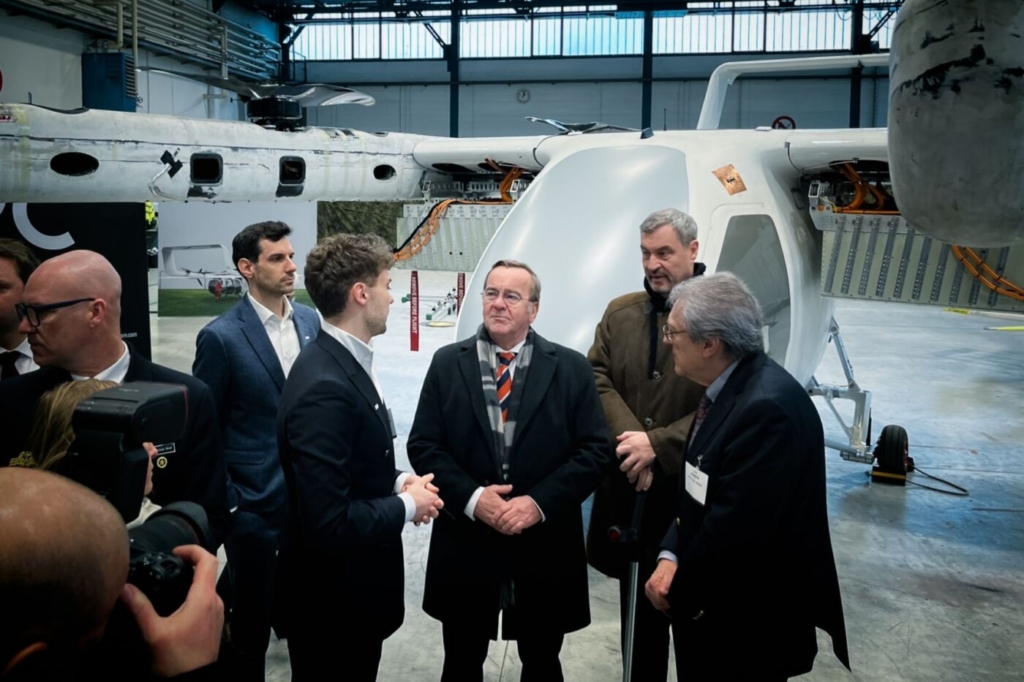
An uncrewed variant is due to be outlined later this year, with potential roles spanning cargo, logistics and government missions. Military use cases could include evacuation or support operations in environments where runway access is limited.
The emphasis on defence and government markets reflects a broader shift within the European eVTOL sector. With high-profile insolvencies among earlier air taxi developers, investors and operators have become more cautious.
Some industry observers argue that platforms capable of meeting structured institutional requirements stand a better chance of long-term viability than speculative urban mobility concepts.
A cautious emergence in Europe’s crowded eVTOL market
ERC Systems was founded several years ago but chose to remain largely out of the public eye while developing its prototypes. Its emergence now is deliberate. Unlike some previous entrants, the company is positioning itself as an aerospace manufacturer first and a mobility disruptor second.
Certification in 2031 remains an ambitious target. Achieving it will require significant capital and a sustained industrial effort. ERC says it is working with aerospace group IABG for engineering support and expertise as the programme matures.
