
|
Getting your Trinity Audio player ready...
|
SkyDrive founder and CEO FUKUZAWA Tomohiro presented the company’s vision for Japan’s “flying car” era in a press conference at the Foreign Correspondents’ Club of Japan on Wednesday, outlining a timeline aimed at commercial operations and integration with existing transport networks.
The briefing, which consisted of a 30-minute presentation followed by a question-and-answer session, highlighted plans to launch services in 2028 after certification in Japan and the United States.
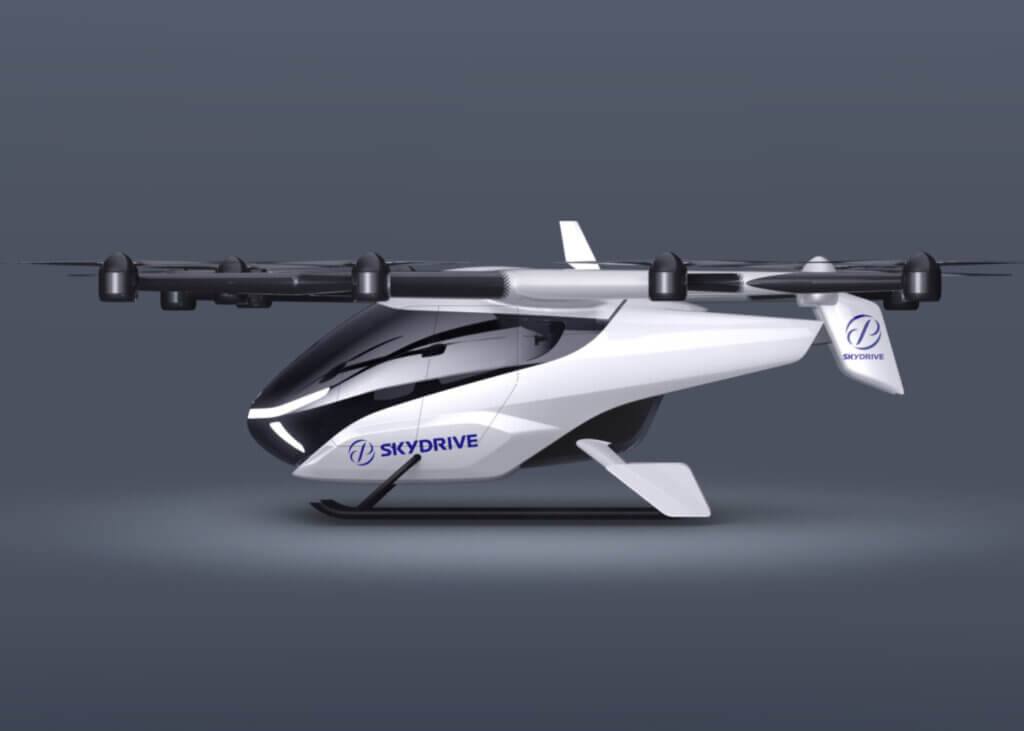
Positioned as a next-generation mobility solution, the electric vertical take-off and landing (eVTOL) aircraft is designed for urban transport, remote regions and disaster relief.
Unlike conventional helicopters, the aircraft uses multiple rotors mounted in different directions, allowing greater stability against both vertical and horizontal winds while maintaining low noise and zero emissions. The model he showed can handle rain, snow and wind at the same level as a helicopter
Because the aircraft is smaller than traditional helicopters, it can use compact landing areas on top of buildings. SkyDrive said this could enable operations at more than 100 locations across Tokyo.
The company is also working with major railway operators to create seamless connections between rail and air travel. By using IC systems such as JR’s Suica card, passengers would be able to transfer directly from trains to air services.
While fares are expected to be higher than taxis, Fukuzawa said the service would be far more affordable than current helicopter sightseeing and charter flights, making air travel more accessible to the public.
A demonstration flight is scheduled for next week in Tokyo, as the company moves toward practical implementation.
SkyDrive has already secured international partnerships and pre-orders across Asia, the United States and the Middle East, and is working with aviation authorities including the Japan Civil Aviation Bureau and the US Federal Aviation Administration to obtain type certification.
Fukuzawa says Japan is at the forefront of bringing eVTOL aircraft into the public domain and commercialization, pointing out that the Osaka Expo was the first example of several such aircraft flying at the same time in a public event, despite efforts in the Middle East and the United States where eVTOL aircraft are in advanced stages of development or deployment.
“People in the Middle East and the United States are quite surprised when they see how much Japan has progressed,” he said. Next week’s demonstration is being conducted in conjunction with the Tokyo Metropolitan government, which has allocated funds for its involvement.
“This collaboration with local governments is also a point where Japan is taking the lead,” Fukuzawa said, who acknowledged that the US and the Middle East are both making progress in the field. “This is why we are in discussions within the industry and also with the Japanese government to ensure that we can convey to the world the progress and the advancement which is being done here in Japan.”
