
|
Getting your Trinity Audio player ready...
|
With backing from the U.S. Department of Transportation (DOT) and the Federal Aviation Administration (FAA), at least eight American vertical take-off and landing aircraft makers are to start tests of their machines in no less than 26 American states this year.
The tests are not only meant to prove the merits of their respective designs, but also to find ways to safely integrate air taxis in the U.S. airspace while adhering to the Advanced Air Mobility (AAM) National Strategy, including by standardizing certification, operations, and infrastructure.
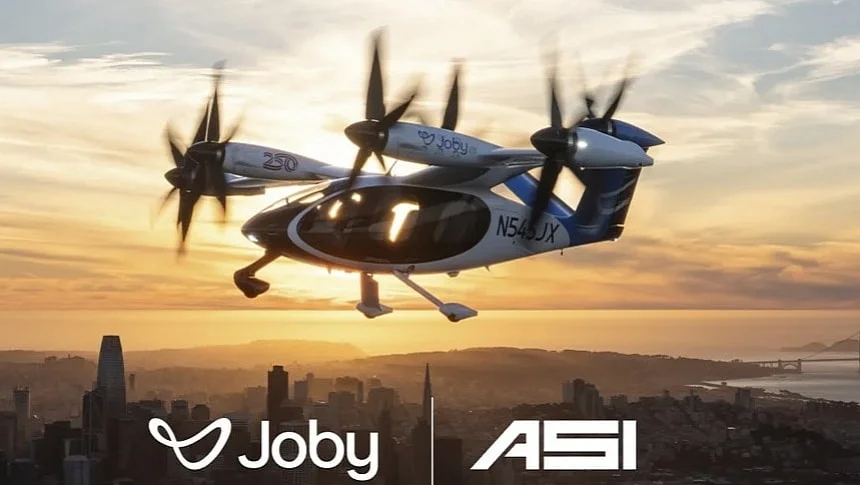
One of the eight VTOL makers that are part of this program is Joby Aviation, whose VTOL design promises top speeds of 200 mph (322 kph, one of the fastest such aircraft around) and the ability to transport four passengers and a pilot in a single go. A vehicle that has attracked the attention of Japanese carmaker Toyota, among others, which started investing in Joby some seven years ago.
As per the plan announced last month by the DOT, Joby will take part in VTOL trials across New England, the Pacific Northwest, the Rocky Mountains, the Plains of Oklahoma, Florida, North Carolina, and Texas. The company has already performed a series of piloted demonstration flights across the San Francisco Bay Area.
To prepare for the start of operations, the company announced this week a deal with American aerospace and defense software company Air Space Intelligence (ASI) meant to “accelerate the integration of advanced air mobility (AAM) into the U.S. National Airspace System.”
More to the point, Joby will integrate ASI’s Flyways AI Platform into operations in a bid to determine how scaled eVTOL operations can safely spread through the complex and high-traffic national airspace. Flyways will assist with this by providing high-fidelity 4D modeling meant to optimize flight operations.
Joby says joint demonstrations of VTOL flights are expected later in 2026, with the initial results of the tests to be made public by the end of the year. We’re told one thing the partnership will look into is how more automated, software-defined approaches to airspace coordination can enable increasingly autonomous flight operations, as per the requirements of the FAA Brand New Air Traffic Control System (BNATCS).
None of the other companies involved in the eIPP program (Archer, BETA, Electra, Wisk, Ampaire, Elroy Air, and Reliable Robotics) has so far made their plans for the rest of the year public.
It’s important to note that whatever comes of the eIPP, although primarily intended to take care of American needs, will likely form the basis of the global VTOL adoption effort, so at the moment, the eyes of this entire segment are glued to what’s happening in North America.
