
|
Getting your Trinity Audio player ready...
|
Acodyne has raised€2.5 million to develop an autonomous, heavy-lift electric vertical take-off and landing aircraft designed to deliver cargo at jet speeds without crew on board.
The pre-seed round, equivalent to about US$2.7 million, was jointly led by Swedish defense venture firm Gungnir Capital and Danish investor PSV Hafnium, with participation from EIFO, SAP9 Group and GreenUP IV Invest.
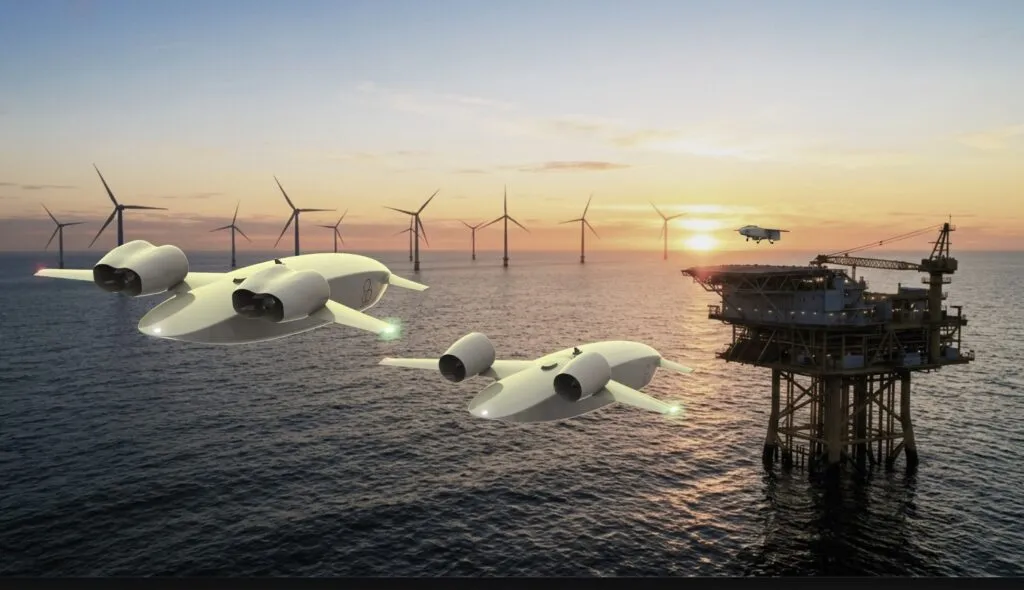
The Copenhagen-based startup is developing unmanned electric vertical take-off and landing (eVTOL) cargo aircraft that combine vertical lift with fixed-wing cruise, pairing a proprietary ducted-fan propulsion system with an artificial intelligence (AI) autonomy stack.
The all-electric aircraft are designed to carry payloads of 220-1,100lb (100-500kg) at a cruise speed of 280mph (450km/h), with a range of up to 310 miles (500km) that extends to 620 miles (1,000km) in hybrid configurations.
A modular airframe with detachable wings allows a complete system to fit inside a standard 20ft shipping container, according to Acodyne.
The company is developing its first model, the E100, with initial flight tests planned before the end of 2026. The funding supports prototype development and flight testing in real mission environments.
Autonomy is handled by eTHOR, an AI flight stack developed with DTU Compute that is designed to enable autonomous take-off and landing for flights beyond visual line of sight.
Acodyne is entering the market as the frameworks for routine unmanned flight mature, including the European Union’s U-space digital traffic management system for drones.
Jasmina Pless, chief commercial officer, said the company’s biggest technical challenge is proving the transition from vertical take-off to forward flight.
Pless said, “Every component and subsystem has been proven before. What we’re doing is bringing those proven elements together in a unique configuration.”
By focusing on cargo rather than passengers, Acodyne aims to avoid the more demanding certification requirements that have slowed the wider eVTOL sector. “By focusing on cargo, we’re removing a major source of complexity while still addressing a significant market need,” said Pless.
