
|
Getting your Trinity Audio player ready...
|
Joby Aviation has begun a series of piloted demonstration flights across New York, offering one of the clearest examples yet of how electric vertical-takeoff-and-landing air taxis could operate on real airport-to-city routes in some of the busiest and most complex airspace in the U.S.
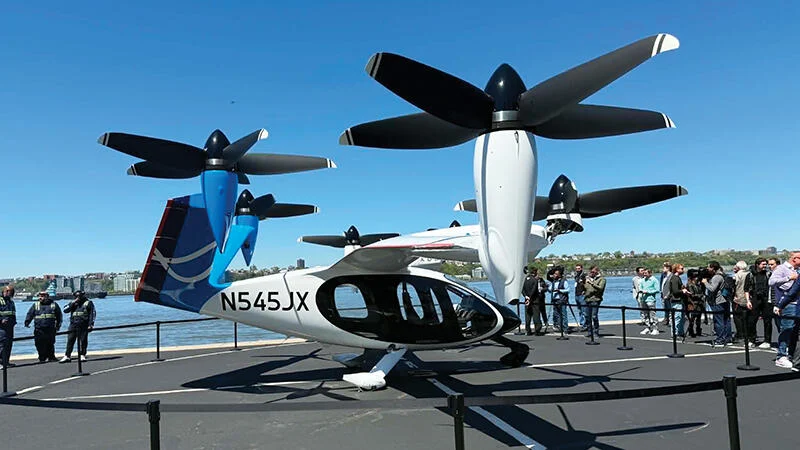
Aviation Week attended the second event in the four-flight campaign on April 27 from Blade Air Mobility’s passenger lounge at the West 30th Street Heliport in Manhattan. Under clear skies and temperatures in the mid-60s, Joby’s S4 aircraft arrived from John F. Kennedy International Airport at approximately 12:30 p.m., landing just outside the heliport terminal after a flight of roughly 7 min. The aircraft remained on the pad for about 20 min. before departing—without recharging—for the return trip.
From inside the Blade lounge, the most striking aspect of the demonstration was how quiet the aircraft was. As it lifted off just feet from the terminal, the sound was barely distinguishable over the chatter inside—a stark contrast from the conventional helicopters that routinely operate from the same heliport.
The flights are part of Joby’s Electric Skies campaign and come ahead of the planned mid-2026 launch of the FAA’s Electric Vertical-Takeoff-and-Landing (eVTOL) Integration Pilot Program (eIPP) in New York, which the company is pursuing in partnership with the Port Authority of New York and New Jersey and Skyports Infrastructure. The program is expected to enable early, limited operations linking Manhattan heliports with regional airports and fixed-base operators.
More broadly, the demonstrations represent a shift from isolated flight testing toward operational validation. While Joby and others have conducted extensive test flights in controlled environments, the New York campaign introduces real-world conditions—dense air traffic, urban infrastructure constraints and complex ground interactions—that more closely resemble eventual commercial service.
Cantor Fitzgerald analyst Andres Sheppard, who was in attendance, said he thought the demo stood out for how closely it resembled a real-world route rather than a controlled test flight. “You’re actually seeing the full mission profile—airport to city center, real airspace, real infrastructure,” he said. “That’s very different from what the industry has been doing up to now, which has mostly been in more controlled environments.”
