
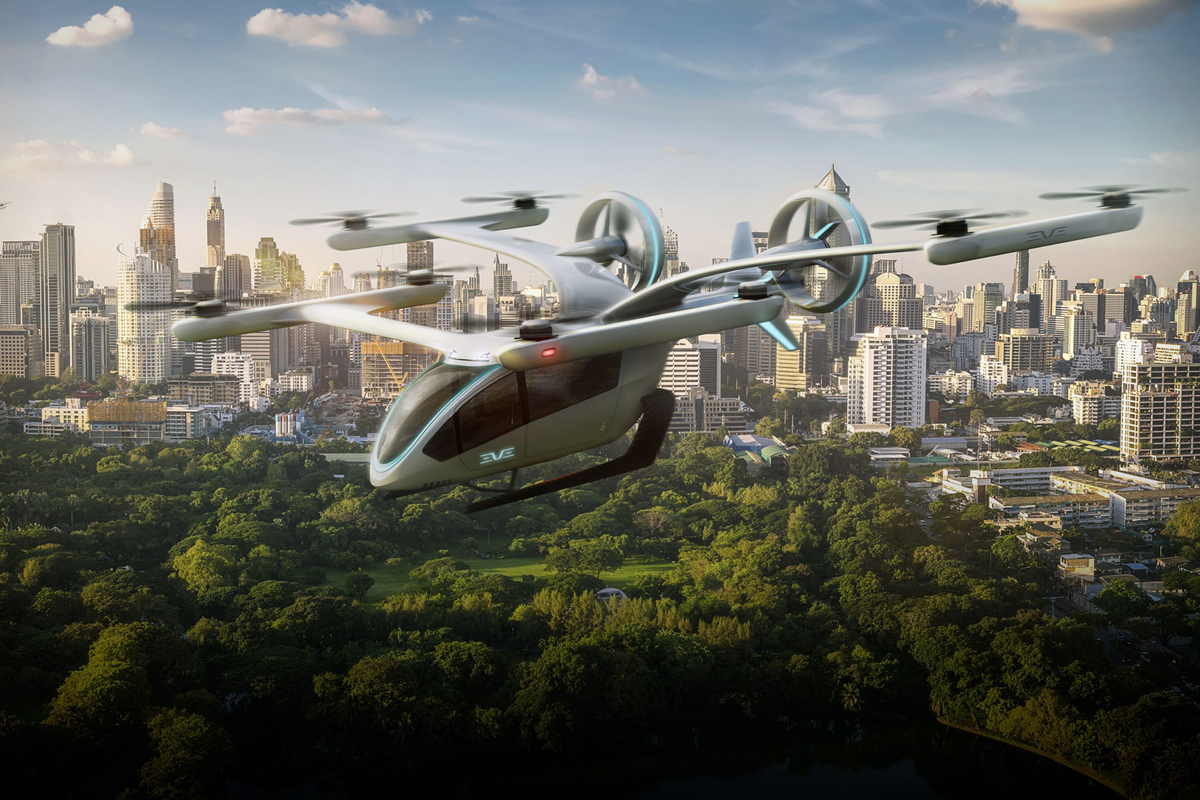
Eve Air Mobility has provided an update on the development programme for its electric vertical take-off and landing (eVTOL) aircraft. Having completed 59 test flights to date, the company is hoping to achieve its first transition flights by the end of 2026, with certification now targeted for 2028.
Eve Air Mobility targets first eVTOL transition flights in 2026
Eve Air Mobility recently provided an update on the progress of its eVTOL aircraft, currently under development. With the flight test phase of its full-scale prototype now well underway, the company said that it is targeting the third quarter of 2026 for the start of transition flight testing.
Eve explained in an investor call held on 5 May that this will involve the switch from deploying the vertical thrust motors to engaging the actuators, lifters, and pusher to move the aircraft along the horizontal axis, initially achieving flight speeds of 30 knots and above, and building up to speeds in excess of 85 knots.
The transition phase will be gradual, explained Johann Bordais, Chief Executive Officer, Eve Holding, Inc. “We will start with a partial transition, progressively increasing speed. The lifters will be engaged to provide the aircraft with the necessary vertical support. At the end of this phase, we plan to accelerate the aircraft to a full transition speed above 85 knots.”
“At this point, the entire lift of the aircraft will be provided by the wing, meaning that the aircraft will be wing-borne flight with lifters motors off. This is the aircraft’s ultimate mission. Take off vertically, transition to wing-borne flight, and then transition back to vertical flight for landing procedures,” he added.
Transition: the most important stage of eVTOL development
Most passenger eVTOLs under development are hybrids between helicopters and fixed-wing aircraft. During transition, lift shifts from rotors to wings, while thrust vectors rotate or hand off, and airflow changes rapidly across the aircraft. Because of this, flight-control software must continuously stabilise the vehicle.
This is especially difficult because the aircraft passes through a low-speed aerodynamic ‘grey zone’ where neither rotor lift nor wing lift is fully dominant. That is why transition is widely viewed as the defining engineering hurdle for modern eVTOLs. Eve is just one of several developers that are currently working on the transition phase of eVTOL flight.
