
|
Getting your Trinity Audio player ready...
|
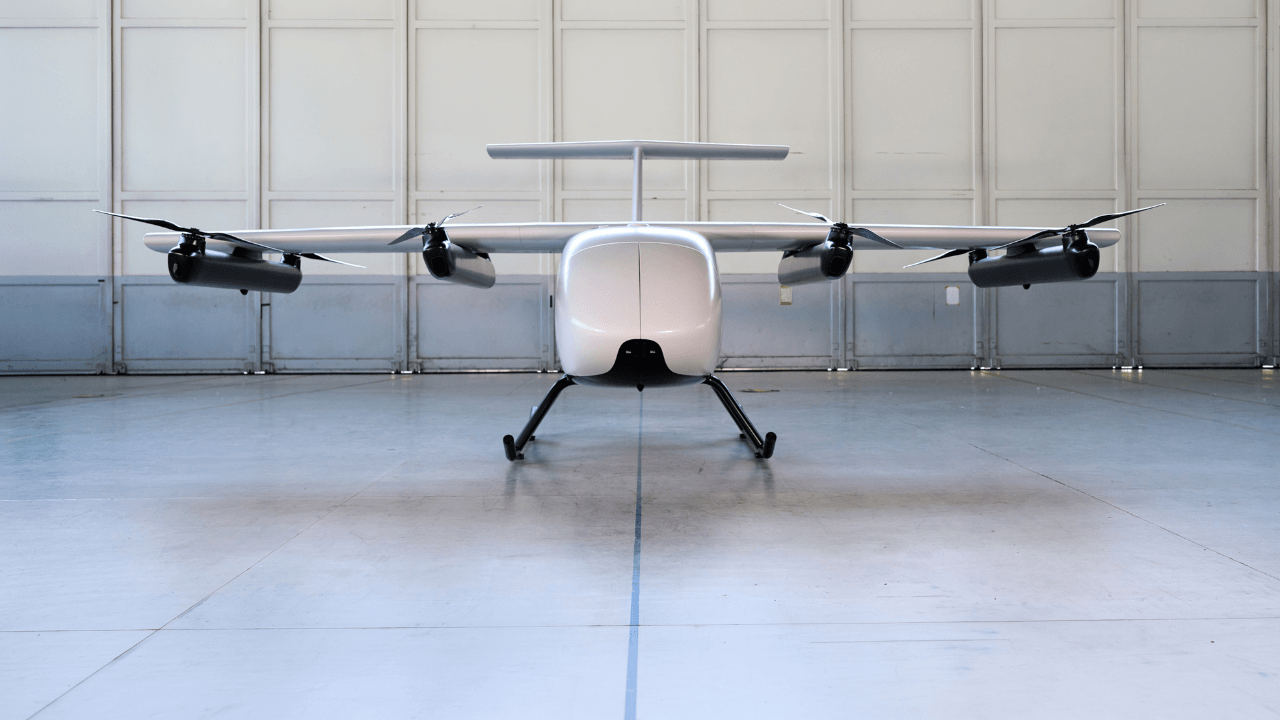
Munich EVTOL company ERC System today announces the launch of “Victor”, a dual-use heavy-lift cargo UAS (Uncrewed Aircraft System) designed for critical missions in fields such as defence, commercial logistics, and disaster response.
Presented publicly at ILA Berlin 2026, Victor aims to close a military capability gap through a scalable, deployable solution for infrastructure-independent, uncrewed aerial logistics capable of carrying payloads over 200 kg.
I spoke to Maximilian Oligschläger, ERC’s Chief Commercial Officer, to learn more.
From medical air mobility to military logistics
Founded in 2020, ERC System develops electrified aviation solutions for critical missions.
The company’s hybrid-electric aircraft take off vertically like helicopters, but fly forward wing-borne, like aeroplanes. They provide high speeds, long ranges, and cost-efficient operations for cargo, patient, and passenger transport as well as uncrewed utility applications.
Victor builds on ERC’s experience designing, building, and flying some of the European Union’s largest electrified aircraft, positioning the company for commercial entry in 2028.
ERC’s product portfolio includes Victor, an uncrewed hybrid-electric lift-and-cruise eVTOL aircraft designed for logistics missions, and Charlie, a crewed eVTOL developed for patient and passenger transport. Victor is scheduled to enter service in 2028, with Charlie expected to follow in 2030.
Check out our earlier interview with ERC System CEO Dr David Löbl.
Through its Charlie programme, ERC has already developed and tested multiple full-scale, full-mass prototypes.
Before Victor, there was the full-size, full-mass prototype Romeo, in which the company began flight testing its full-size Romeo prototype in November 2025.
Operated remotely in an uncrewed configuration, Romeo has a take-off weight of approximately 2.7 tonnes and is believed to be the heaviest uncrewed eVTOL currently flying in the EU, based on publicly available information.
It follows the earlier Echo demonstrator, which validated core capabilities such as controlled lift-off and stable hover while providing valuable system-level data for subsequent aircraft development.
