
|
Getting your Trinity Audio player ready...
|
Eve Air Mobility is preparing to make the first low-speed transition flight of its Eve 100 eVTOL in the coming weeks. This milestone, which Eve predicts will happen shortly before the Farnborough International air show in July, will precede a full-speed transition at 90 knots later in the year.
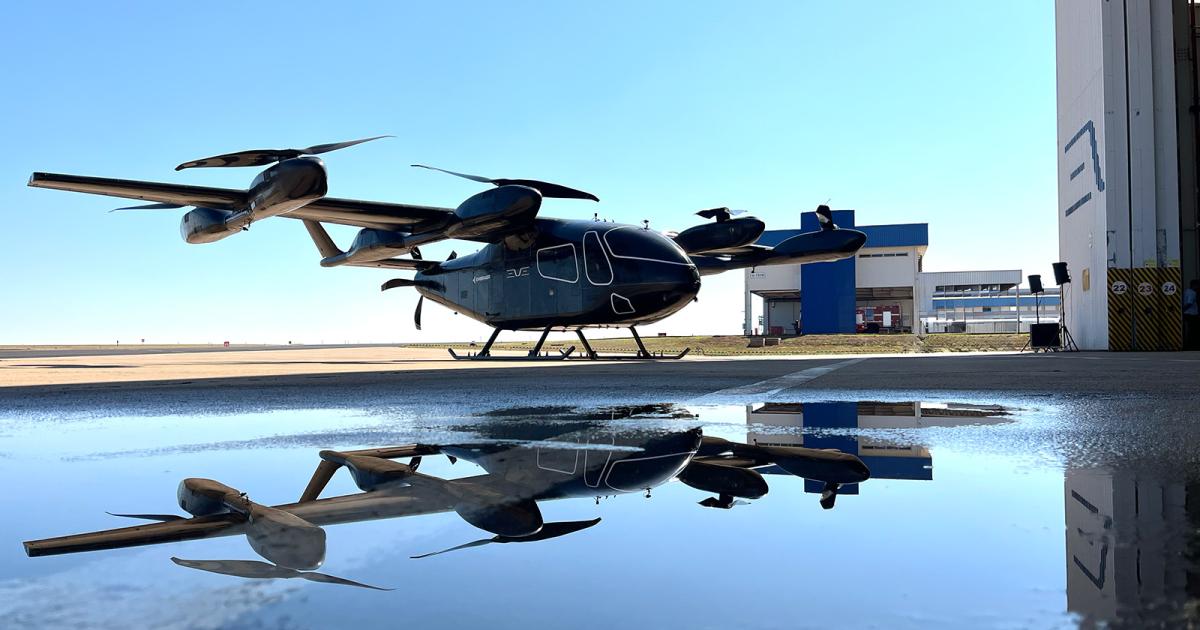
To date, the Embraer spin-off’s full-scale uncrewed prototype has made 59 flights since December 2025. With a total of two hours, 27 minutes, and 33 seconds of accumulated flight time on the clock, the technology demonstrator is currently in a lay-up phase ahead of the next stage of flight testing. This will see it make its first airborne transition from horizontal to vertical flight at up to 50 knots.
After this initial flight envelope expansion, Eve intends to make what it terms a ‘full transition’ at almost twice that speed in the third quarter of the year. “That’s when we’re going to have all the data that we need to transfer to the conforming prototype,” explained Eve CEO Johann Bordais, during a recent media briefing in Brazil.
According to Bordais, the new aircraft will be “very close to a conforming prototype” in terms of the type certification process being worked through with Brazilian civil aviation regulator ANAC. However, he did acknowledge that there could be “a couple of tweaks here and there” before a fully conforming example is produced.
Although he conceded that this upcoming aircraft may potentially include “a couple of tweaks here and there,” he explained that the successor will be “very close to the conforming prototype” the Brazilian civil regulator will be certifying.
In total, the current engineering prototype is expected to make up to 130 flights with a total of some ten hours airborne. While this aircraft’s duration is limited to around seven minutes, the battery system on the next variant—also provided by BAE Systems—will support greater range. During the course of the certification campaign, this will be swapped out once more for a yet more mature battery, intended to offer Eve its projected 85 kilometers (46 nm) of range, with energy reserves.
Type Certification Target
The first of five crewed test aircraft is expected to make its first flight around July 2027. These will be assembled at Embraer’s Ozires Silva plant and transported to the Gavião Peixoto factory for completion. Around 800 Embraer engineers have input into the eVTOL program, something Bordais describes as a “core differentiator” to other eVTOL OEMs.
Eve expects to conclude its flight test campaign in the second half of 2028, prior to Brazilian certification and U.S. validation later that year. Having also applied to EASA during the second quarter of this year, the company expects European certification to follow some 12 to 15 months later after its ANAC and FAA approvals.
