
|
Getting your Trinity Audio player ready...
|
Archer Aviation (ACHR) has drawn fresh attention after its partners in Texas, Florida and New York were selected for the White House’s eVTOL Integration Pilot Program, a regulatory step that could influence expectations around future air taxi commercialization.
Despite the regulatory progress around the eVTOL Integration Pilot Program, Archer’s share price has been under pressure, with a 30 day share price return of 9.6% and a year to date share price return of 24.72%, while the 3 year total shareholder return is a very large gain from a low base. This indicates that momentum has recently cooled even after substantial earlier gains.
If this kind of early stage air mobility story interests you, it can be worth widening your watchlist to see which other AI linked infrastructure names are moving through the growth phase, starting with 34 AI infrastructure stocks
With Archer’s shares sitting well below analyst targets yet already reflecting big expectations around eVTOL commercialization, the key question is whether today’s price still leaves upside on the table or whether the market is already pricing in future growth.
Most Popular Narrative: Fairly Valued
Archer closed at $6.12 and the most followed narrative on Simply Wall St does not assign a specific fair value, so readers are left weighing the story more than a number.
ACHR, also known as Archer Aviation, is a company that has lately been overlooked but at the same time is heavily represented in ETFs. ACHR is currently year to date down 1.58%. The company has received some attention from the media in the past several months, during which the share price increased 199%. The narrative discussed here focuses on several of the company’s recent major contracts with the Department of Defense (DOD). ACHR has secured a position with the US Government through fixed-term contracts. Under these agreements, the company expects to receive periodic lump-sum payments from the government for its services. Some technical indicators are described as sending mixed signals, with long-term bullish patterns and short-term bearish ones. The original commentary suggests that quarterly reports could be a key catalyst for renewed momentum.
The narrative, according to TeamDaily, leans heavily on future contract cash flows and a strong revenue ramp, with valuation shaped by expectations for margins to eventually flip the company into sustained profitability.
Result: Fair Value of $0 (ABOUT RIGHT)
However, those expectations could be challenged if government contract timing disappoints, or if Archer’s recent revenue of about US$0.3m remains out of step with investor hopes.
Another View: Discounted Cash Flow Signals More Upside
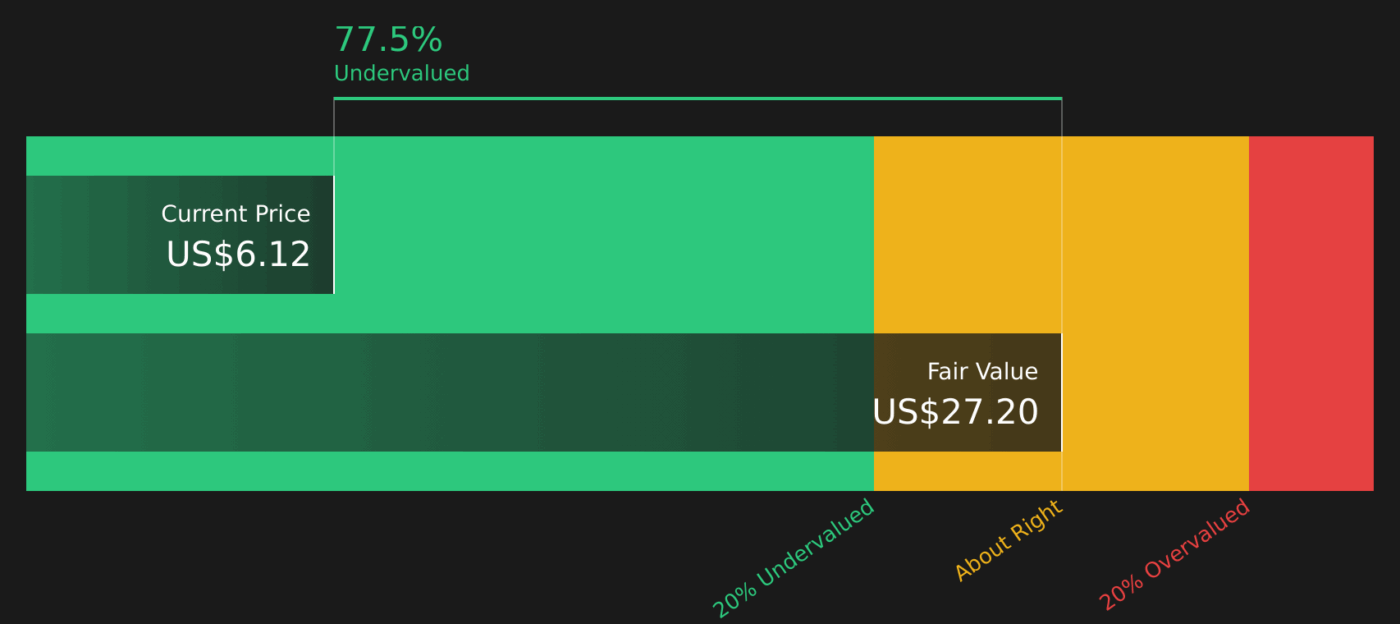
While the most popular user narrative lands on a fair value of $0, our DCF model presents a different perspective. At a share price of $6.12, Archer is trading around 77.5% below an estimated future cash flow value of $27.20. This suggests a wide gap between current expectations and the assumptions used in the DCF model. For you as an investor, the key consideration is whether those long range cash flow forecasts seem realistic enough to potentially narrow that gap.
Simply Wall St performs a discounted cash flow (DCF) on every stock in the world every day (check out Archer Aviation for example). We show the entire calculation in full. You can track the result in your watchlist or portfolio and be alerted when this changes, or use our stock screener to discover 47 high quality undervalued stocks. If you save a screener we even alert you when new companies match – so you never miss a potential opportunity.
Looking for more investment ideas?
If Archer has caught your eye, do not stop here. Broaden your watchlist and compare it with other potential opportunities before committing fresh capital.
- Target income focused ideas that still aim for resilience by scanning companies in the 15 dividend fortresses.
- Hunt for candidates where quality and value intersect by reviewing the 47 high quality undervalued stocks.
- Prioritize peace of mind by concentrating on companies that score well on stability using the 74 resilient stocks with low risk scores.
