
|
Getting your Trinity Audio player ready...
|
First of all, we are delighted to have the opportunity to speak with you today, especially given your connection to Yokohama F. Marinos. To begin, I’d like to ask about the broader context of tourism in Japan. Japan has continued to fascinate travelers worldwide for more than 150 years. However, this year stands out for two key reasons: Japan ranked No. 1 in the World Economic Forum’s Travel & Tourism Development Index, and inbound tourism is expected to reach 40 million visitors. With that in mind, why do you believe Japan has become such a major global travel destination?
Japan’s appeal lies in the unique balance between deeply rooted traditions such as historical landscapes, cultural heritage, and craftsmanship and highly modern, innovative services and infrastructure. This harmony can be experienced throughout the country. Furthermore, the government has strongly promoted tourism as a national strategy, investing in international gateways and improving the environment to welcome global visitors.
As a result, Japan’s so-called “Golden Route” has become incredibly popular. However, beyond this route, there are countless regions with equally rich and distinctive charm. I believe one of Japan’s next major goals is to help travelers discover these deeper, lesser-known experiences across the country.
In that context, what role do you believe air mobility particularly the kind of aerial travel experiences your company provides can play in the next phase of Japan’s tourism strategy?
I believe air travel has two major advantages: the enjoyment of the scenery and the efficiency of movement. Many international travelers only have one or two weeks in Japan. If they attempt to explore areas outside major urban centers via ground transportation, they often lose an entire day just in transit. With air mobility, however, destinations 100 kilometers away can be reached in 20 to 30 minutes.
And during that journey, the flight itself becomes an experience the landscape from the sky is something that cannot be replicated on the ground. For example, when flying over Nikko during peak autumn foliage, the mountains look like a vast tapestry of color. Japan has countless landscapes like this, each beautiful in different seasons.
Our electric vertical take-off and landing (eVTOL) aircraft also offer quiet, eco-friendly, and affordable flight options. They allow visitors to experience both breathtaking views and responsible travel. Japan has many national parks and areas where preserving the natural landscape is essential, and these aircraft enable access while maintaining harmony with the environment.
Your company also contributes to regional revitalization by bringing visitors beyond the Golden Route. Could you share examples of how your services are being used today?
At present, we serve approximately 20,000 passengers annually, and many use our flights for sightseeing, regional mobility, and special travel experiences. While popular routes include Tokyo’s night scenery especially because the dense skyline is visually stunning—we also see strong demand for access to areas such as Mount Fuji, Ise-Shima, Amanemu, and Hakata.
Each region offers unique cultural, historical, and culinary value. Our flights help visitors experience these areas efficiently and in a memorable way.
For our 65 million global readers, many of whom are luxury travelers, what experiences would you especially recommend? And are there new experiences on the horizon?
One very popular experience is a day trip from Tokyo to the Mount Fuji area. Visitors can enjoy regional cuisine such as handmade soba noodles or taste tea grown in the foothills of the mountain experiences deeply tied to local culture.
As winter approaches, Japan’s powder snow regions, such as Hakuba in addition to Niseko, are also highly attractive. We plan to offer a range of experiences there, from advanced heli-skiing to casual scenic flights and even aerial-access picnics in the mountains an experience that is already available in New Zealand, and which we are now preparing to offer in Hakuba.
Could you share the share of inbound customers among your users, and your outlook for future inbound growth?
For example, on our Mount Fuji sightseeing routes, around 93% of passengers are inbound travelers. The growth rate among international guests is extremely strong. To support this, we are enhancing multilingual services and developing a more intuitive booking app that allows travelers to reserve flights effortlessly even verbally.
The app adapts to real sky conditions and allows users to instantly see where they can fly, meaning visitors will be able to casually integrate air mobility into their travel plans. We expect this to accelerate inbound demand significantly.

When will the app be available?
The beta version will be released early next year, with the official launch scheduled for April. Additionally, we are introducing the first Aston Martin–Airbus collaborative helicopter in Japan. As Aston Martin Residences expand in Japan, we are designing a seamless travel experience that combines air and ground mobility between these destinations. Approximately 20 luxury destination routes are being developed across Japan.
Your international expansion includes France, Switzerland, and New Zealand, and you have welcomed a COO to support this. Why were these three regions chosen?
Our mission is not simply to operate flights we aim to create transformative lifestyle experiences enabled by the sky. France and New Zealand already have mature helicopter ecosystems and abundant natural landscapes that align with emotional, experiential travel. There is both sophisticated tourist demand and capable operational infrastructure.
This balance allows us to deliver meaningful aviation-based lifestyle experiences that feel natural and valuable for travelers.
Looking toward further global expansion beyond these three regions, what areas are next?
In Europe, we are preparing expansion into Italy and the United Kingdom. In Oceania, we plan to expand from New Zealand into Australia. In North America, our first step will be Hawaii, followed by select mainland regions.
While we aim to operate in at least ten countries by 2025, the level of involvement will differ by market—some require aircraft leasing and operational support, while others primarily need our reservation and operations platform.
Regarding global strategy, will your growth focus on partnerships, M&A, or establishing local subsidiaries?
We are open to all approaches. While partnerships are currently central, we are also receiving M&A inquiries. We evaluate each market case-by-case to determine the most effective expansion structure.
Ultimately, what is your long-term vision for air mobility?
Our goal is to help create a new mobility infrastructure a lifestyle revolution. Today our role is primarily tourism-oriented, but air mobility will eventually support daily life: commuting, accessing remote schools, medical transport, and emergency response.
This changes how people choose where they live. When distance becomes effortless, lifestyle options expand dramatically. This is not only for Japan, but globally.
The eVTOL field is progressing rapidly, transitioning from testing to commercialization. How do you balance innovation speed with safety, regulation, and public acceptance?
Air mobility requires much more than aircraft it requires flight zones, trained pilots, maintenance personnel, operational infrastructure, and community trust. We are already developing all these elements through our helicopter operations. Because we are building the ecosystem now, we can integrate eVTOL aircraft seamlessly when they arrive.
Our platform connects owners, operators, service providers, and passengers. As eVTOLs become available, we already have the demand, operational structure, and flight environments in place.
You have also been involved in vertiport development and testing, including Gotemba and Tsukuba. How do these projects support Japan’s readiness for eVTOL implementation?
Different aircraft will serve different purposes depending on range and passenger capacity, so versatile infrastructure is essential. Currently, flight locations, public understanding, and talent pipelines are still insufficient. Our role is to strengthen the overall ecosystem building flight sites, coordinating with local governments, supporting pilot and maintenance training, and enabling early real-world implementation.
We are also launching rooftop vertiport demonstrations in Osaka with special regulatory approval, enabling business travel and inter-city movement from building to building. Over time, this will become a natural part of urban mobility.
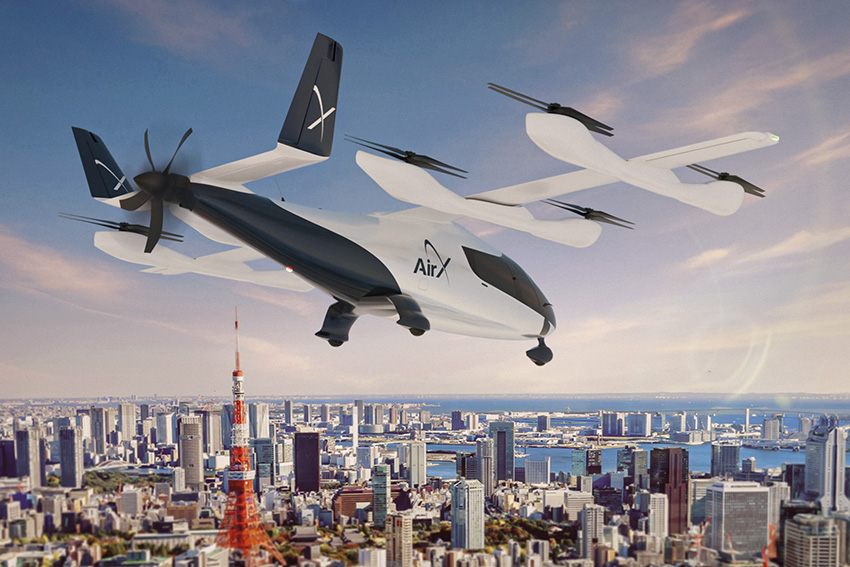
Could you explain the key strengths of the AirX Vertiport Platform?
Traditional aviation depends heavily on maximizing aircraft flight hours due to high operating costs. However, future air mobility must integrate more like personal transportation—similar to how cars became part of everyday life even without high usage rates.
Our platform is designed as a scalable ecosystem. It supports not only passengers, but also aircraft owners, service operators, maintenance providers, and vertiport managers. We enable revenue generation and operational efficiency across all participants.
For travelers, we provide seamless, digital-first booking and availability management, ensuring stress-free access. This usability will be a major differentiator in the eVTOL era.
You also offer fractional ownership, membership programs, and aircraft sales. How do these business segments work together, and are there future areas you plan to expand?
All segments reinforce each other. Increasing the number of aircraft on our platform expands available destinations and improves convenience. Enhanced maintenance increases safety. Reduced cost improves accessibility. And the more enjoyable and reliable the experience, the more individuals choose ownership, membership, or frequent use.
As the global fleet grows from tens of thousands of helicopters today to potentially millions of eVTOL units the platform will scale to support safe, enjoyable, community-integrated flight experiences for all participants.
You recently raised 1.25 billion yen and are preparing for an IPO around 2026–2027. Why pursue an IPO, and how will it support your long-term goals?
Beyond funding, an IPO enhances credibility, transparency, and long-term stability. As we evolve into mobility infrastructure, we must demonstrate reliability and alignment with public interest, regional development, and national policy goals. Public markets allow us to welcome stakeholders who share our mission, and they reinforce trust in the long-term continuity required for infrastructure-level mobility systems.
If we were to speak again five years from now, what do you hope your company will have achieved?
By then, eVTOL aircraft will be naturally integrated into daily travel something people simply use without thinking. Visitors to Japan and residents alike should be able to rely on AirX to move comfortably, intuitively, and beautifully between destinations. This applies globally, across all markets where we operate.
Moreover, air mobility will support not only tourism but also everyday life and emergency response expanding human possibility while preserving safety.
