
|
Getting your Trinity Audio player ready...
|
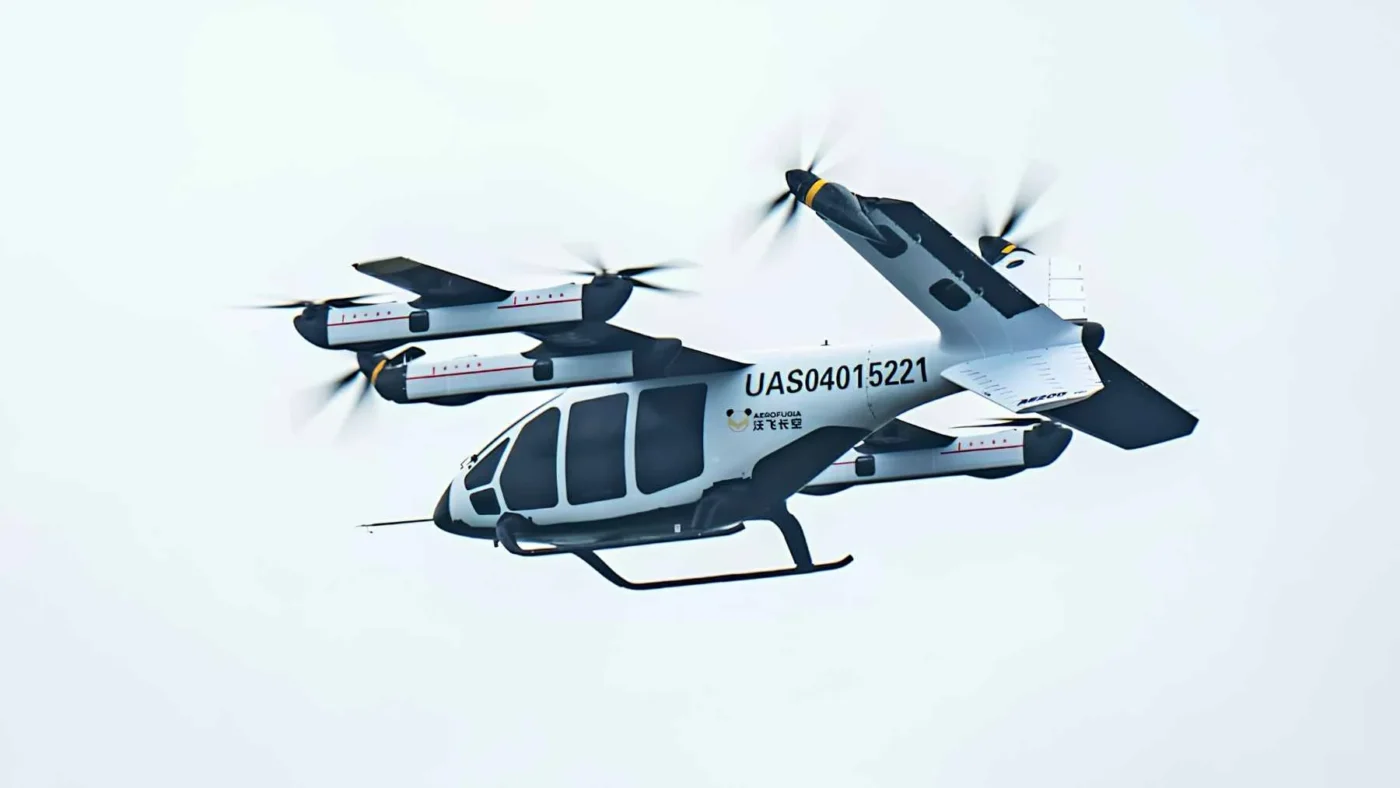
China has unveiled a small, weapon-capable electric vertical takeoff and landing aircraft called the Superwing ZR-300, pitched for fast urban security missions like surveillance and rapid response.Reports say it has been tested with the Lianyungang Public Security Bureau, which points to a law-enforcement role rather than a front-line military one.
It is a sharp turn in the push for a “low-altitude economy,” where drones and short-range aircraft operate below 1,000 meters. But there is a twist hiding in plain sight. Will the next wave of “green aviation” start with cameras, sirens, and missile mounts?
What the ZR-300 is
The ZR-300 is described as an optionally piloted eVTOL that can also fly by remote control or autonomous modes, with a head-linked aiming interface for targeting.
Its modular payload concept is what makes it stand out, with published images and reports pointing to configurations that include a 5.56 mm machine gun pod, unguided rockets, and light missiles such as AR-2 or QN-202. Even the naming hints at how early-stage this still is. The same reporting references a DM-03 modular missile launcher and elsewhere describes a DL-03 modular payload system, which underlines that specifications are still being discussed more than they are being standardized.
There are also no disclosed production contracts or unit prices, and no public confirmation of procurement by the People’s Liberation Army.
Electric motors produce no exhaust at the point of use, so an eVTOL hovering over a street corner will not add combustion fumes to the air people are breathing. That can matter in dense neighborhoods where smog and humid summer days already make outdoor air feel like a bad deal.
But emissions do not vanish, they shift upstream to the grid. The International Energy Agency forecasts China’s power-sector carbon intensity will fall from about 565 g CO₂ per kWh in 2024 to about 505 g CO₂ per kWh in 2026, and that number is what quietly decides the climate impact of every recharge that shows up on the electric bill.
If the alternative is a conventional helicopter, the potential carbon savings can look meaningful, even for short missions. A commonly used aviation accounting factor is that burning 1 kg of Jet A-1 releases about 3.16 kg of CO₂, so a few quick hops can add up. Research on eVTOL “air taxi” concepts suggests some electric VTOL configurations can emit less CO₂ per passenger-kilometer than several helicopter types, although results depend on the power mix and assumptions.
The same studies also find eVTOLs can be worse than public transportation, and in many cases, worse than ground electric vehicles in urban use. That nuance matters, because a police eVTOL is most likely to replace a helicopter sortie or a patrol vehicle stuck in traffic, not a subway train.
