
|
Getting your Trinity Audio player ready...
|
Vision Aero, a low-altitude mobility company, has completed an angel extension round worth an eight-figure RMB sum. The round was led by Orinno Capital, with participation from Jinduo Investment.
The funds will primarily be used to accelerate R&D iteration, maiden flight testing, and airworthiness certification for the company’s first flagship model, Vector 5. Founded in 2023, Vision Aero focuses on the R&D and manufacturing of eVTOL (electric vertical takeoff and landing) and eCTOL (electric conventional takeoff and landing) aircraft with high passenger capacity and heavy payload capabilities. Including the seed and angel rounds it completed six months ago, Vision Aero has now closed three funding rounds, raising more than RMB 100 million (USD 14.7 million) in total.
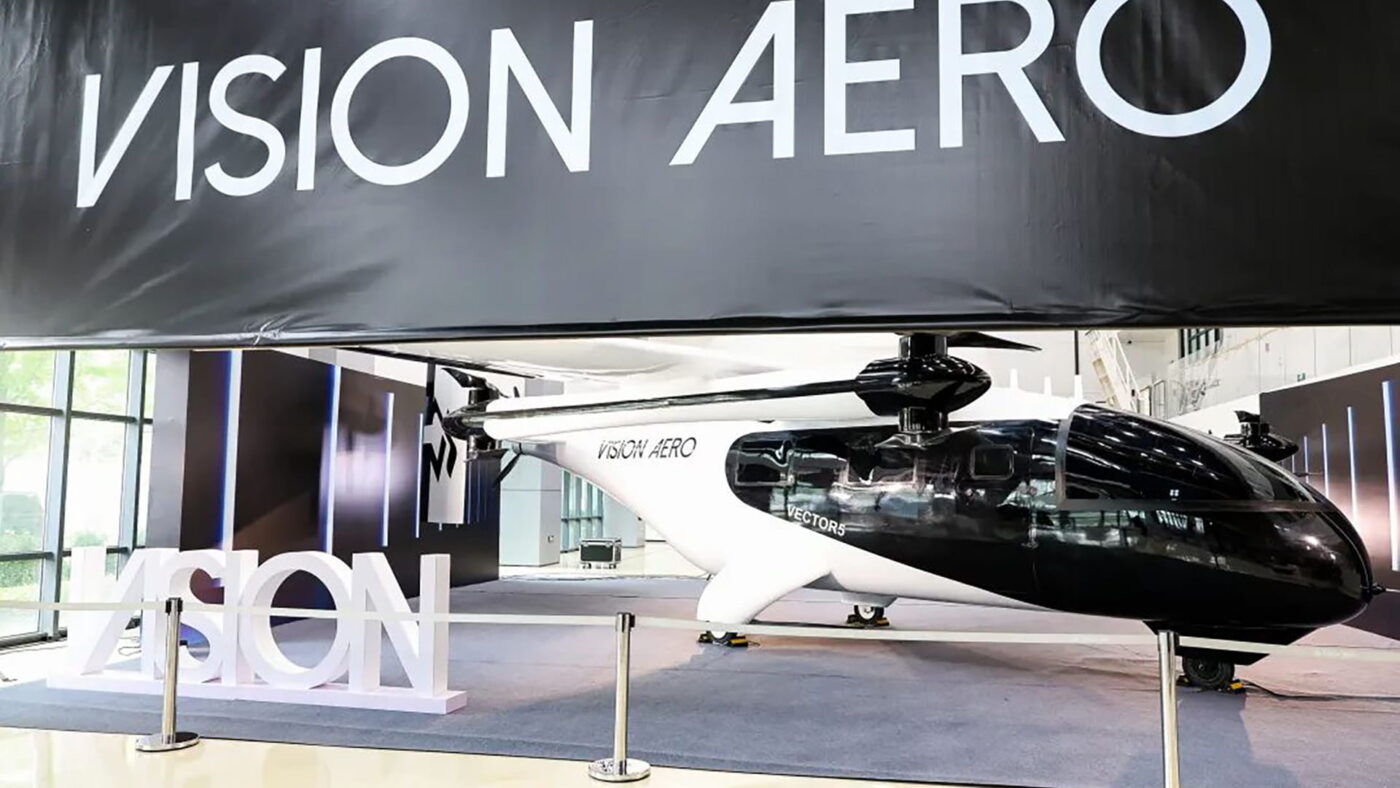
Vision Aero’s flagship model, Vector 5, is a seven-seat, three-ton-class, all-electric lift-plus-cruise eVTOL aircraft. It is designed for essential public service scenarios such as emergency rescue and medical response. The model has a maximum takeoff weight of 3,180 kilograms, a maximum payload of 680 kilograms, a maximum range of 300 kilometers, and a top cruising speed of 250 kilometers per hour. Its full-scale prototype officially rolled off the production line last June.
According to Vision Aero founder and CEO He Wei, the company completed the maiden flight of Vector 5’s full-scale frame aircraft in late March. A frame aircraft refers to a 1:1 full-scale aircraft skeleton that integrates all equipment required for the complete aircraft, including motors, electronic control systems, batteries, and flight control systems, for integrated testing. This avoids the cumbersome process of repeatedly removing and reinstalling access panels, improving testing efficiency while reducing structural wear.
Vision Aero has reportedly completed dozens of flight-test integration sessions for the frame aircraft in the first half of this year, in preparation for the maiden flight of the full-scale Vector 5 prototype in July.
On airworthiness certification, the Northwest Regional Administration of the Civil Aviation Administration of China formally accepted Vector 5’s type certificate application on December 8 last year, bringing both the complete aircraft and its core subsystems into the certification process. Under Vision Aero’s development plan, the first cargo version of Vector 5 is expected to complete certification by the end of 2027. The company has now entered a critical window in its push toward airworthiness approval.
In addition to concentrating resources on improving Vector 5’s technical maturity and advancing certification, He said the company is also developing its second-generation model, Vector 11, an 11-seat, three-ton-class fixed-wing eCTOL aircraft. The full-scale prototype is expected to roll off the production line by the end of this year, further extending Vision Aero’s product lineup from three-ton-class aircraft to models with greater carrying capacity.
Vision Aero said it will next focus investment on three R&D areas: flight control technology, fast-charging infrastructure, and low-altitude communications. The company aims to continue advancing key aviation technologies and keep its core capabilities independently controllable. Together with further improvements to its external supply chain system, these efforts are intended to move its products from the engineering prototype stage toward commercial delivery.
