
|
Getting your Trinity Audio player ready...
|
Speaking exclusively to AGN, Horizon Aircraft CEO Brandon Robinson explains why the company believes rugged hybrid VTOL aircraft capable of IFR and icing operations will outperform many urban air taxi concepts in real-world service.
When you’re designing a VTOL for Canada, it’s got to be tough. That’s the message from Horizon Aircraft CEO Brandon Robinson, speaking exclusively to AGN about the development of its Cavorite X7 VTOL aircraft.
The Cavorite has already passed some key milestones. The large-scale prototype has completed full transition flights – a hover takeoff, transition to forward flight, back to hover and vertical landing – and the team is hard at work building the first full-size aircraft for flight testing.
When the Cavorite rolls out of the factory, it will mark a step change in advanced air mobility. Few aircraft using a comparable fan-in-wing architecture have progressed beyond experimental testing. The 1960’s Ryan XV-5 Vertifan showed promise, but ended up being too unstable in the transition to continue with.
The fan-in-wing is not just a novel vertical lift mechanism. It is also crucial to fulfil Cavorite’s role as a hardy, go-anywhere aircraft.
“We’re designing, from the very start, a really tough machine,” Brandon told AGN.
Why Horizon’s Cavorite differs from typical eVTOL air taxis
While many AAM companies pursue all-electric urban air taxi concepts, Horizon’s Cavorite is designed with utility in mind. From search and rescue and medical evacuations to passenger and cargo transport, the built-in-Canada aircraft targets operations in the toughest environments.
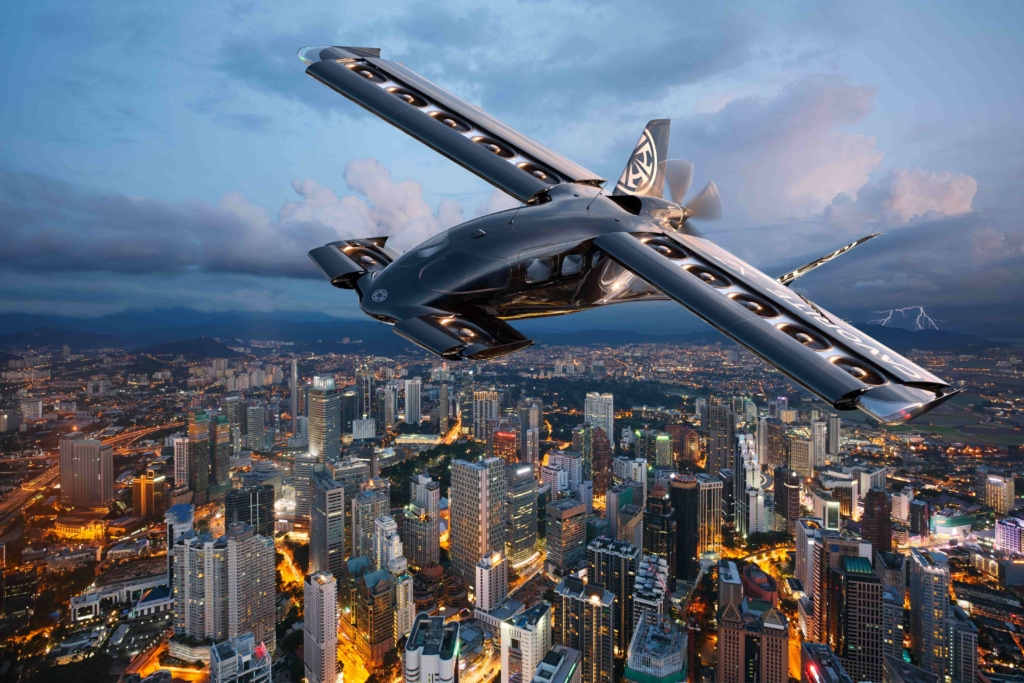
The secret sauce that will allow Horizon to deliver this is that unique fan-in-wing architecture. Unlike multicopter-style eVTOLs, Cavorite uses fans hidden inside the wings to provide vertical lift and landing. Once in the air, a traditional pusher prop provides forward momentum, while the fans are once again hidden by the wing surface.
“The all-electric VTOL companies have these massive tilt rotor mechanisms,” Robinson says. “Those rotor mechanisms are horrendously expensive, and they will require significant inspection cycles.”
In contrast, the Cavorite has been engineered to behave more like a light aircraft in flight, with a lifting solution that is both simple and incredibly clever. As well as avoiding the use of heavy, complex tiltrotor mechanisms, the CEO says this design will also be cheaper and easier to maintain.
“Our blades are an order of magnitude cheaper to maintain,” Robinson adds. “They’re all fixed pitch … you can just drop one out and put another one in.”
