
|
Getting your Trinity Audio player ready...
|
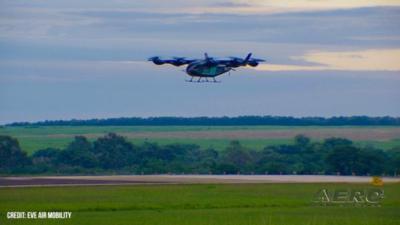
Eve Air Mobility recently flaunted its full-scale engineering prototype to the people who stand between it and its operational future in Brazil: Brazilian President Luiz Inácio Lula da Silva and other high-ranking government officials. The event gave the eVTOL manufacturer a chance to showcase its flight test progress as it nears its target certification date of 2027.
Since its first flight in December 2025, the prototype has completed 35 short flights, totaling nearly 1.5 hours of flight time. Early testing has focused on baby steps, working up to 15 knots to validate flight control laws, rotor aerodynamic performance, propulsion modeling, and thermal behavior. The aircraft has reached 140 feet above ground level and demonstrated stable handling, including coordinated inputs across three axes.
While hundreds of flights remain in the test campaign, data from completed missions put propulsion and battery performance above initial expectations. Projected noise levels, one of its primary selling points, remain far lower than those of conventional helicopters. Eve says that flight envelope expansions will come in the upcoming phase, targeting operations up to 30 knots as the eVTOL proves its stability.
“We are advancing with discipline and consistency in our flight test campaign, reducing risk and building the foundation for future certification flights,” said Eve CEO Johann Bordais. “The results achieved in these first months following our initial flight in December 2025 reinforce our confidence in the aircraft’s architecture and our ability to deliver a safe, efficient and scalable solution for the urban air mobility market.”
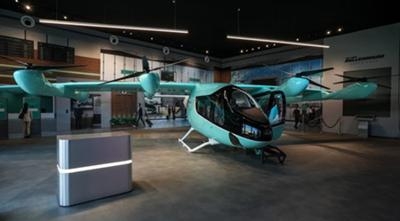
As impressive as it is to see the eight-rotor electric aircraft in the air, the behind-the-scenes operations are just as crucial to the program. Eve has completed countless ground-based evaluations, including sensor calibration to measure aerodynamic loads in real-world conditions. Certification remains dependent on meeting technical milestones and securing regulatory approval from Brazil’s National Civil Aviation Agency (ANAC).
Work on that front seems promising. The company is a subsidiary of the by far the largest and most well-known manufacturer in Brazil: Embraer. It has also established partnerships to support nearly every step remaining to entry-to-service, including air traffic management software integration with Signature Aviation and a full-flight simulator for pilot training from CAE.
So, though the certification runway remains long, at least it’s looking like Eve’s efforts will pay off.
